who pays for cheap food?
the price on a menu pays for growing, cooking and serving. part of what food costs is paid somewhere else: in health care, in a warming climate, in rivers carrying too much nitrogen, in farm work that pays less than other work.
none of it is on the bill. all of us pay it, later.
1. the bill nobody sees.
contents11.6
trillion dollars a year
hidden costs of food systems in 156 countries, 2020, in dollars adjusted for what money buys in each country [1]
the UN’s Food and Agriculture Organization added up the costs of food that never appear on a price. about 70% of the total comes from diets and what they do to our health. the rest is the climate, the land, nitrogen in rivers and soil, hunger, and farm workers living in poverty.
almost two thirds of Portugal’s hidden cost is health. the single largest part, 7,263 million dollars or 30%, is diets short of whole plant foods: whole grains, fruit, vegetables, pulses, nuts and seeds [2].
| cost | million dollars | share |
|---|---|---|
| health, from diets | 15,605 | 64.5% |
| land cleared or changed | 4,137 | 17.1% |
| nitrogen | 3,004 | 12.4% |
| greenhouse gases | 1,457 | 6.0% |
| farm workers in poverty | 7 | under 0.1% |
| total | 24,210 | 100% |
2. paid for twice.
contents
£116
billion more
what the same food cost later, in health care, lost income from ill health, and repairing the land, water and climate [3]
for every pound spent on food in the UK, another 97p is paid somewhere else [3]. we pay once at the till. we pay again through taxes, bills and our health, whether we bought the cheap food or not.
3. why good food looks expensive.
contentsMaasdamer cheese, 300 g
- on the shelf
- €2.49
- left off the price
- €2.35
- true price
- €4.84
one product taken apart, from the Penny week, 2023 [4]
for one week in summer 2023, a German supermarket chain sold nine products at their true price [4]. researchers added what each one costs the soil, the climate, water and our health. here are six of the nine. the packs are different sizes, so the percentage added is the fairer comparison.
the organic products cost more at the till. as a share of their price, less was left off them.
every product left some costs off the price, the organic ones included [4]. the plant-based schnitzel left the least.
4. how sure are these numbers?
contents
they are estimates, built from models. read them as a sense of scale.
FAO’s first count, in 2023, came to 12.7 trillion dollars [5]. a year later, with better data, it became 11.6 trillion [1]. a separate group of economists puts it at about 15 trillion [6]. the numbers move. the size of them does not.
what FAO counts [1]:
- greenhouse gases
- land cleared or changed for farming
- nitrogen lost to rivers, soil and air
- farm workers living in poverty
- hunger
- illness linked to diet
what it does not count yet: costs with too little data to price, such as harm from pesticides and worn-out land [5]. two economists argue that the totals add together very different kinds of cost, and some that food is not to blame for [7]. that is fair, and a reason to keep counting more carefully.
5. what flavour lost along the way.
contents
for decades, crops were bred to be bigger, firmer and quicker to grow, so they would travel well and cost less. along the way, flavour was often overlooked [9]. a 2017 study of 398 tomatoes found 13 aroma compounds linked to flavour at lower levels in modern varieties than in heirlooms [9].
older is not always tastier. in France, Italy and Spain, tasting panels tried traditional and modern tomatoes, all chosen for their good name, and on the whole gave the modern ones more tomato flavour [10]. flavour comes from the whole journey: a good variety, picked ripe, grown in the ground, eaten in season. even the fridge takes its share: tomato aromas suffer below 12 °C [11].
the narrower the choice of crops, the narrower the choice of tastes. every old variety still growing is one more flavour a cook can reach for.
6. the seeds still here.
contents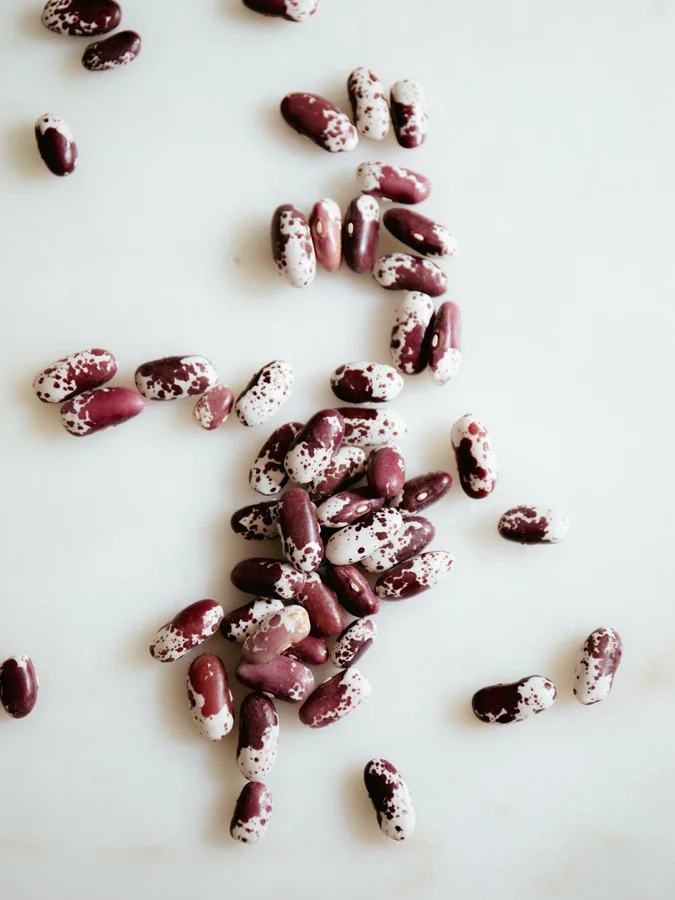
the north of Portugal and Galicia still hold crops that almost went.
barbela, an old Portuguese wheat named after a goat’s beard, grows on thin, sloping land in Trás-os-Montes [12]. modern short-stemmed wheats nearly pushed it out, until farmers, millers and bakers began saving and sowing it again [13]. it is on Slow Food’s Ark of Taste, a catalogue of foods at risk of disappearing within a few generations [14].
in the Sousa valley, farmers and scientists have been breeding maize for broa together since 1984. they choose for what small farms need and for good bread, not only for yield [15].
and in Galicia, black oat (avea moura) was grown for animals until the 1980s, then almost left behind as the countryside emptied [16]. from 2023 a team led by the Misión Biológica de Galicia, with the Fundación Juana de Vega, trialled six old varieties in fields across Galicia. the crop turned out hardy and able to take drought, and it needs less added to the field than other crops [17].
that project ended in September 2026, and the work goes on. more than twenty volunteers have taken seed of Pastoriza, the most productive of the six, to sow across Galicia, and about ten farmers took the crop into their rotations this year [18].
what we do with this: we cook with barbela, tarrestre beans and millo corvo, a black maize grown around Bueu in the Rías Baixas of Galicia, all of them on the Ark. and the black oat team is giving us Pastoriza grain for our kitchen, and a kilo of seed each for two of the farmers we buy from, to sow this winter. the seed started as a small sample from a seed bank, so every field that grows it makes more of it.
if our kitchen finds a good use for the grain, those farmers have a reason to keep sowing it.
7. the farmer’s share.
contentsabout 60%
of other wages
what farmers in the EU earn, on average, compared with wages in the rest of the economy (2023) [19]
the hidden bill is also paid on the farm.
of all the value the European food chain adds, from field to plate, farming holds about a quarter [20]. the rest is made in factories, warehouses, shops and kitchens. in the United States, of every dollar spent eating out, 7.5 cents reaches the farm [21].
restaurants are part of that chain, us included. much of what a dinner costs is the room, the people who cook and serve it, the energy. that is exactly why we care where the farm’s part goes.
where we can, we buy directly from the farmers and makers, so what we pay reaches them. if the person who grew the food cannot make a living from it, something in the chain is broken, however good the food is.
8. what a good farm gives back.
contents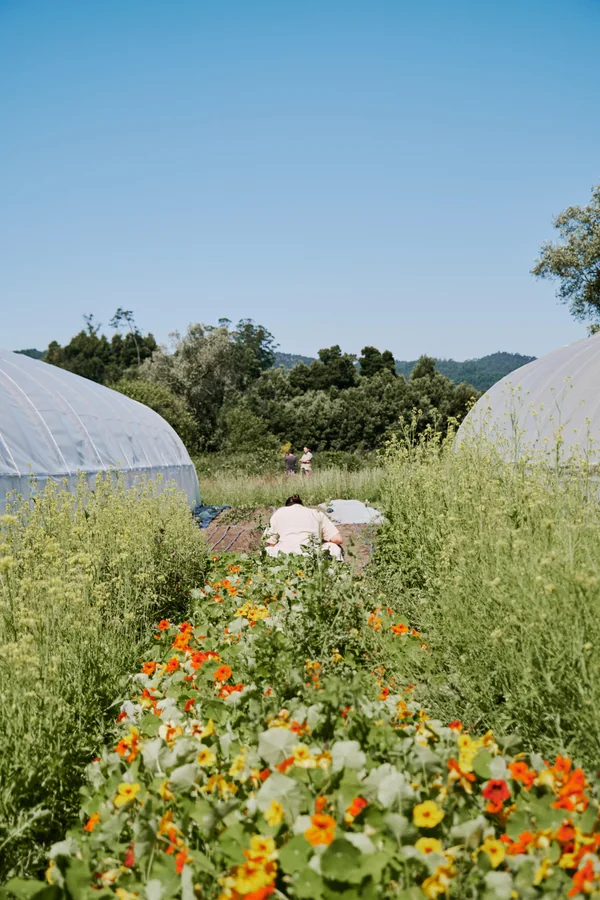
the hidden bill has a mirror: good things a farm does that no price pays for either.
a 2020 review brought together more than 5,000 studies comparing farms that grow many things with farms that grow few [22]. it looked at mixing crops, hedges and flower strips, cover crops, rotations and less tilling.
where farms were more diverse, the review found more wildlife and pollinators, more insects eating the pests, more fertile soil, better nutrient cycling and water held better in the ground. and on the whole, harvests held up [22].
healthy soil, clean water and bees are not on any invoice. the farmers who look after them carry the cost, and everyone around them shares the good.
some of the farmers we buy from grow like this, with many crops in small fields and trees among them. buying from them is one way of paying for what their land does for everyone.
9. the book on our shelf.
contents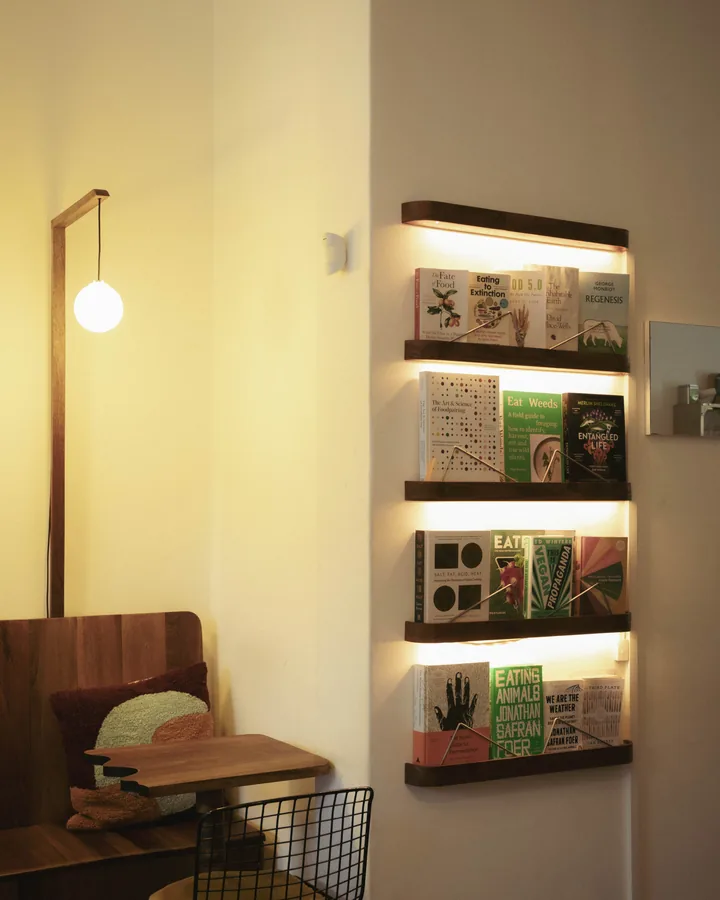
there is a copy of The Third Plate on our shelf at the restaurant. the New York chef Dan Barber wrote it in 2014, after ten years visiting farms and fisheries [23].
he describes three plates. the first is a large piece of meat with a few vegetables on the side. the second is the same plate, made better: grass-fed meat, organic carrots from a nearby farm. it tastes better and is kinder to the planet, but it is built the same way [24].
the third plate starts from the farm. it cooks what the soil needs grown, the crops sown between harvests to rest and feed the ground, the whole of what a field gives [25]. good farming and good food meet there.
the book moves through soil, land, sea and seed [26]. it takes the reader to the dehesa in Spain, the oak pasture where some of the acorns in our flour come from. and it ends with plant breeders who choose for flavour.
our plates have no meat, so we start further along. the questions are the same. which crops does a farm need us to cook? which old variety needs a kitchen before a farmer can bring it back? what will grow here as the climate changes? every menu is our attempt at an answer.
10. what we do, and what we haven’t solved.
contents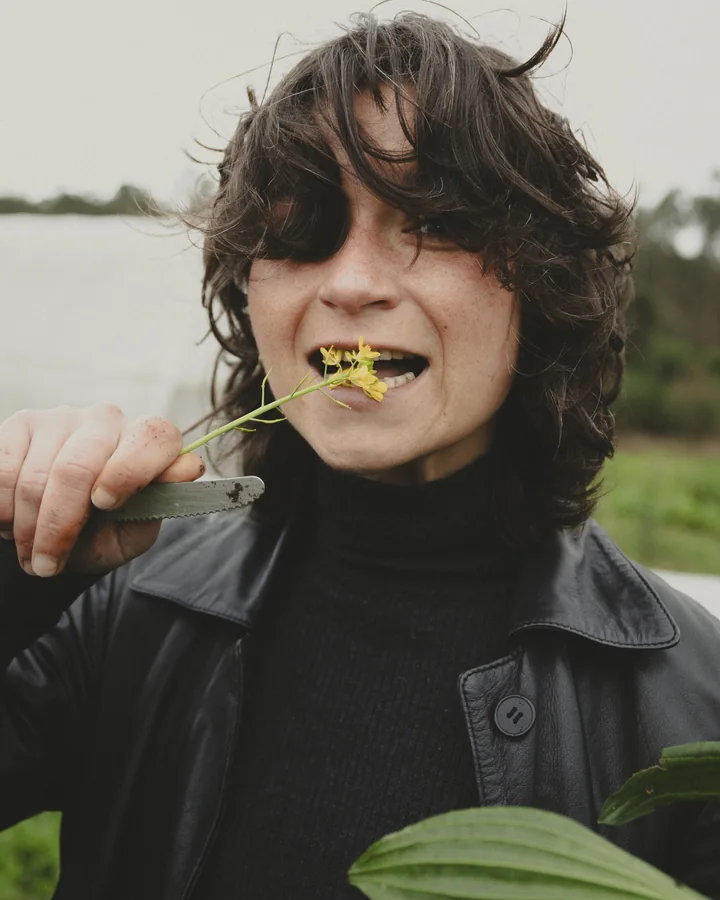
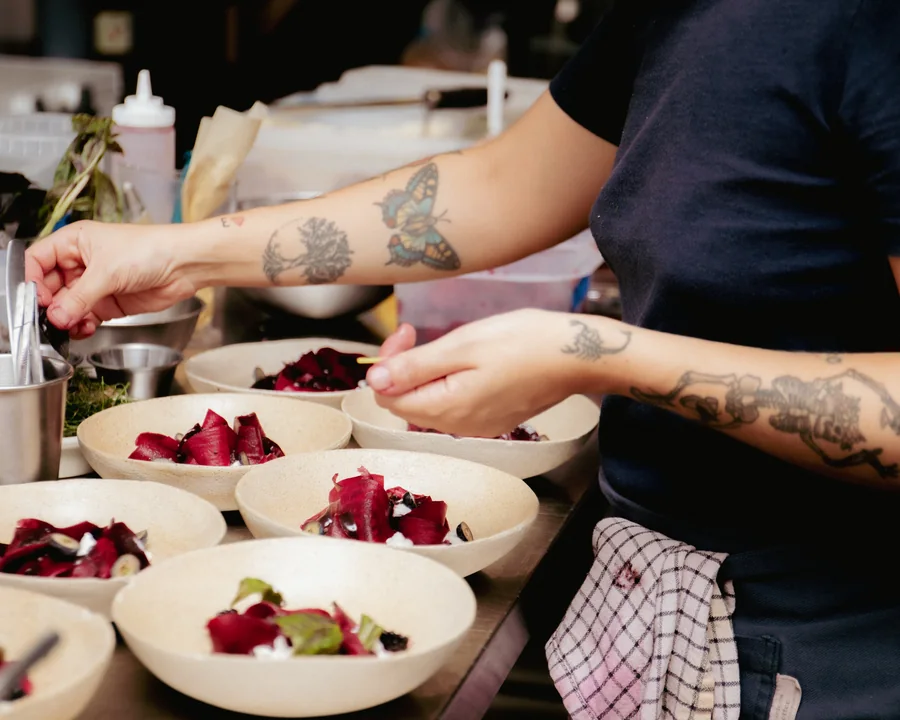
we are one small restaurant. we can’t put the hidden bill on anyone’s receipt. we can choose who we buy from, what we cook, and say openly what we have not got right yet.
- we cook plants. beans, peas and nuts are among the foods with the smallest climate footprint for the protein they give [27]. we cook them because they are delicious first.
- we buy close to the source. most of what we spend on ingredients goes to farmers and makers we can name, or to plants foraged in the wild. the provenance page shows them all, live from our invoices.
- we are trying a new way to pay farmers. with one farm we are working on a pilot where a restaurant pays ahead for part of the harvest, plans the planting with the farmer and shares the risk of a bad season.
- we give old crops a kitchen. we cook with foods on Slow Food’s Ark of Taste, and the team bringing back the Galician black oat is giving us grain to cook and seed for two of our farmers. an old Alentejo purple carrot is growing for us now, and more seed is going in until December. the first should be ready next year.
- we give back to the trees. while acorn flour is on the menu, 3% of the tasting menu price goes to Gigantes Verdes, who look after the region’s largest trees. that’s VERDE.
what we haven’t solved.
some of our loops are still open. a lot of what is left in the kitchen becomes the next dish, but not all of it. we don’t weigh what goes in the bin yet. that is the next step.
we have opened about a third of the concrete in our patio. the rest is still to do.
we don’t run a programme for our neighbourhood. we tested an open table, mesa aberta, in summer 2025, and it isn’t running now.
we are independent and pay for all of this ourselves. every choice has to work for the farms, for the restaurant and for what we believe, at the same time. sometimes that means going slower than we’d like.
cheap food is paid for in the end. by the soil, by rivers, by people’s health, by the farmer. we would rather pay at the start, where you can see it.
where the numbers come from
- FAO, The State of Food and Agriculture 2024. global quantified hidden costs, 2020 PPP dollars. doi.org
- FAO, The State of Food and Agriculture 2024, Annex 2, Table A2.1, p. 107. Portugal, millions of 2020 PPP dollars, by category, with the four costs from diets. doi.org
- Sustainable Food Trust, The Hidden Cost of UK Food, revised edition (2019), “Hidden costs in 2015”, p. 8. UK, 2015, pounds at 2015 prices. sustainablefoodtrust.org
- Penny “Wahre Preise” week, 31 July to 5 August 2023; true prices calculated by TH Nürnberg and the University of Greifswald. shelf and true prices as reported by Öko-Test. oekotest.de
- FAO, The State of Food and Agriculture 2023: Revealing the true cost of food. 12.7 trillion 2020 PPP dollars; omitted costs listed. doi.org
- Food System Economics Commission, The Economics of the Food System Transformation, January 2024. about 15 trillion US dollars a year. knowledge4policy.ec.europa.eu
- J. Brooks and E. Díaz-Bonilla, “How helpful are the ‘hidden costs of food systems’ numbers?”, Food Policy 131 (2025), 102796. doi.org
- FAO news release, 22 February 2019, on The State of the World's Biodiversity for Food and Agriculture. fao.org
- D. Tieman et al., “A chemical genetic roadmap to improved tomato flavor”, Science, 27 January 2017. 398 tomatoes, 13 compounds. eurekalert.org
- F. Sinesio et al., “Sensory Traits and Consumer’s Perceived Quality of Traditional and Modern Fresh Market Tomato Varieties”, Foods 10 (2021), 2521. doi.org
- B. Zhang et al., “Chilling-induced tomato flavor loss…”, PNAS 113 (2016), 12580 to 12585. doi.org
- Slow Food Foundation, Ark of Taste: Barbela wheat. fondazioneslowfood.com
- The Tribe of Barbela, practice abstract, BOND project, 2020. bondproject.landworkersalliance.org.uk
- Slow Food Foundation, The Ark of Taste. fondazioneslowfood.com
- P. Mendes Moreira, S. Pêgo et al., on the VASO participatory maize breeding project, Sousa valley, since 1984 (AGRIS record). agris.fao.org
- Fundación Juana de Vega, 12 January 2024, on the black oat project. juanadevega.org
- Fundación Juana de Vega, 24 September 2025, first prototypes and trial results. juanadevega.org
- Fundación Juana de Vega, 23 September 2026, final results of the Avea Moura project and next steps. juanadevega.org
- EU CAP Network, CAP Strategic Plans results brief, 2025. EU, 2023. eu-cap-network.ec.europa.eu
- EU CAP Network, Guidelines: Assessment of farmers' position in the food chain, June 2026, Box 3. EU, 2022. eu-cap-network.ec.europa.eu
- USDA Economic Research Service, Food Dollar Series, summary findings, updated 17 November 2026. United States, 2025. ers.usda.gov
- G. Tamburini et al., “Agricultural diversification promotes multiple ecosystem services without compromising yield”, Science Advances 6 (2020), eaba1715. doi.org
- Dan Barber, The Third Plate: Field Notes on the Future of Food, Penguin Press, 2014 (publisher's description). penguinrandomhouse.com
- The Third Plate, publisher's synopsis (Powell's). powells.com
- Jennifer Weeks, review of The Third Plate, SEJournal, 2014. em.sej.org
- Marion Nestle, review of The Third Plate, Food Politics, 2014. foodpolitics.com
- Our World in Data, Environmental impacts of food, from J. Poore and T. Nemecek, Science 360 (2018). ourworldindata.org
figures checked 23 November 2026.